Hmong Elements
These Hmong features are part of the China Friendship Garden; a garden based on the sister-city relationship between St. Paul and Changsha in Hunan Province, China. Inclusion of these features recognizes that St. Paul has the largest urban Hmong population in the U.S. and the Hmong trace their ancestral roots to this area of China; and the sister-city Changsha is home to 2 million Hmong.
Hmong Heritage Wall

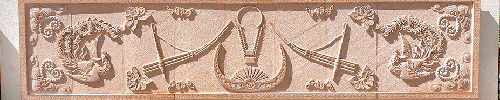
Carved Red Granite Sculpture: 22’ long x 5’ high
The Hmong Heritage Wall features cultural symbols of both the Minnesota Hmong and the Hmong in the Changsha area (Hunan Province) of China. Its prominent placement in the China Friendship Garden educates visitors about the historical and cultural connection of the Minnesota Hmong to their ancestral homeland in China.
The design for the Hmong Heritage Wall was a collaboration between the MCFGS Board, the MCFGS Hmong Advisory Group, and the Changsha Hunan Jianke architects. It is made of “Yongding Red Granite” and was fabricated in nine panels in Changsha, Hunan Province, and shipped to MN. It was the first feature to be installed at the China Friendship Garden at Phalen Park in 2019.
Hmong Plaza

“Be pure as rice, strong as rock, healthy as green grass, and transparent as water”
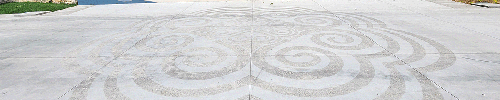
Traditional Hmong saying represented in the Hmong Plaza: “Be pure as rice, strong as rock, healthy as green grass, and transparent as water”
The Hmong Plaza is an educational, cultural, performance space. It was designed in collaboration with the St. Paul Parks & Recreation Department’s Design Advisory Committee (that included local Hmong leaders, artists, and community members), the Changsha Hunan Jianke architects, and MN China Friendship Garden Society, among others. The Hmong Plaza was completed and opened in 2024.
Symbolism of the Hmong Heritage Wall & Hmong Plaza
Silver Necklace

The Hmong Silver Necklace cultural symbol, “Paug” or “Xauv,” is found on both the Hmong Heritage Wall and the Hmong Plaza. The silver necklace is a type of traditional Hmong jewelry that consists of a necklace, two chains and a pendant. Styles vary among the clans. It is most commonly made of silver.
Hence, the Paug or Xauv is often known as Paug Nyaj or Xauv Nyaj, meaning “Silver Necklace.” The Paug or Xauv can be worn by all ages and both genders. It is worn during New Year celebration, weddings, and special events, etc. Traditionally, the paug or xauv is used as a decorative accessory, engagement dowry, and for spiritual healings.
The Paug or Xauv has many important representations, including a good life, pride, ambition, wealth and beauty. However, notably, it is a symbol of Cultural Wealth.
Qeej (“kheng”) Musical Instrument
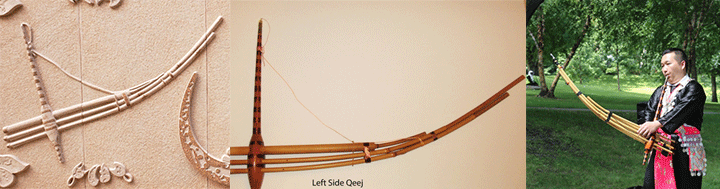
The Hmong Qeej cultural symbol is found on both the Hmong Heritage Wall and the Hmong Plaza. The Qeej is a type of free-reed multiple pipe musical instrument. It consists of a hollow wooden body and six bamboo pipes. The six pipes are placed perpendicular to the wooden body. The hollow wooden body is comprised of a wind chest with a long tapering neck leading to a mouth piece. Each of the bamboo pipes has a finger hole and brass reed on the section that is inserted within the wooden wind chest. Sounds are produced when air is passed through the reeds causing them to vibrate with inhalation or exhalation accompanied by variable finger placements on the holes of the six pipes. The Qeej is different from other types of reed instruments in that the sounds produced by the Qeej are the sounds of the Hmong spoken language, meaning every note or sound has an equivalent Hmong word.
The Qeej has many uses in the Hmong culture, including funeral rituals, wedding ceremonies, and for all other musical entertainment purposes. To the Hmong, the Qeej is not just a musical instrument, but it is a symbol of Cultural Identity.
Hmong Headdress
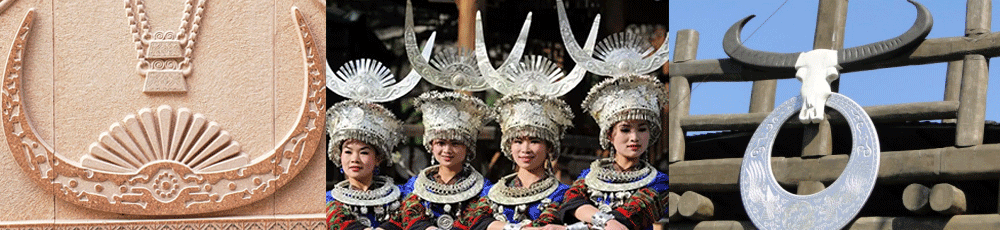
The Hmong Silver Oxhorn Headdress cultural symbol is found on the Hmong Heritage Wall. These headdresses are worn only on very special occasions, like weddings or significant festivals. They include five different parts: the horn, the crown, the comb, the flowers and the hairpin. They are crafted to mimic the horns of an ox and to represent strength. They may be adorned with silver flowers representing happiness and reproduction.
The two horns can be up to one meter apart. They are often engraved with an image of two dragons playing with a pearl – a symbol of an auspicious future. Some women decorate the horns with various types of silver pendants. The crown, the basis of the headdress, is made of silver and can be quite heavy.
Phoenix Bird

The Phoenix Bird cultural symbol is found on the Hmong Heritage Wall. The Phoenix is often described as a composite of many birds and embodies the virtues of benevolence, righteousness, propriety, wisdom, and sincerity. It is a messenger of happiness, and wards off evil. Seeing a Phoenix is an auspicious sign and it was once believed to only appear during times of peace and prosperity. A rare treasure could be found where the Phoenix stopped to rest.
The Phoenix is often paired with the Dragon, the symbol for masculinity and the emperor. Together they represent the Emperor and Empress, and more commonly, a husband and wife; a symbol of the union between the masculine or Yang and the feminine or Yin. The Phoenix is found in both Hmong and Chinese cultures. Any mythological similarity with the Phoenix found in Western culture is superficial.
Hmong Embroidery Elements – Paaj Ntaub or Paj Ntaub (“pa ntau”)

Hmong cultural symbols of butterflies, flowers, and hearts are found on the Hmong Heritage Wall in the form of paaj ntaub embroidery art. Each of the four corners of the heart, which represent the four corners of the world signifying compassion, integrity, humility, and friendship. Butterflies join the hearts in each of the four corners, representing “Mother Butterfly” – motherhood, reproduction, and happiness. Butterflies are the most important totem in China Hmong culture.
Paaj ntaub or Paj ntaub is a type of Hmong reverse appliqué and batik textile art, literately meaning “flower cloth.” It is an elaborate, bright and contrasting color embroidery that consists of natural geometric shapes and designs. The Paaj Ntaub or Paj Ntaub is commonly used to decorate traditional clothing. Hmong women embroider the images of butterflies, dragons, buffaloes and birds on clothes, quilt covers, sheets and curtains, as symbols of their ancestors, and the reverence due them. Tradition believes that these record the Hmong written language and literature. Shapes and designs differ according to regions, and symbolizes Hmong cultural arts and crafts.
Hmong Elephant Footprint
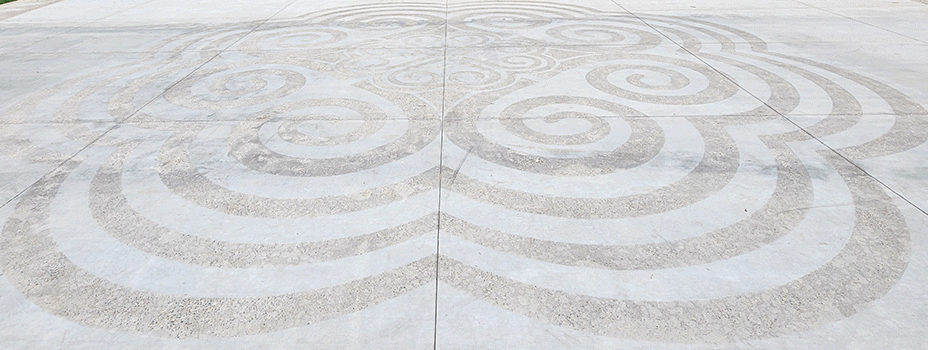
The Elephant Footprint cultural symbol is found in the center of the Hmong Plaza. The elephant footpring comes from Hmong Paj Ntaub/Paaj Ntaub embroidery art and is a typical Hmong cultural symbol. It represents a guide to green land; wherever there are elephant footprints, there are rain forests, food, and water; rich lands that can produce maize and rice. Hmong women have used Paj Ntaub/Paaj Ntaub embroidery, embedded with special symbols and meaning, to preserve their stories from generation to generation.
Triangles & Wall Paintings
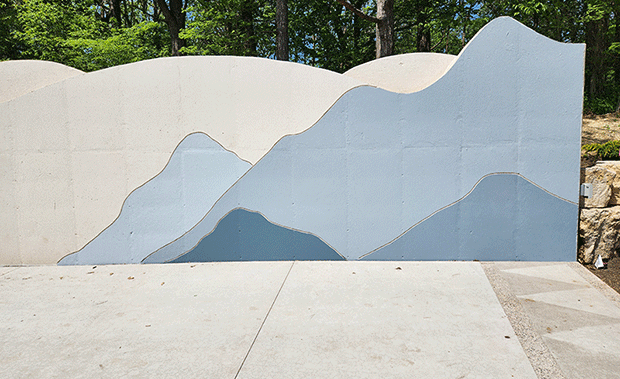
Triangles along the perimeter of the Hmong Plaza floor and wall paintings on the back wall represent mountains. These represent the fact that Hmong people tend to live in higher parts of the country (mountains in China, Laos, Vietnam), and believe that mountains are cleaner, healthier, and have the best views of the world. It is a place to freely grow rice and raise animals; and represents their love of living with nature.
Rice Terrace Rock/Grass Borders
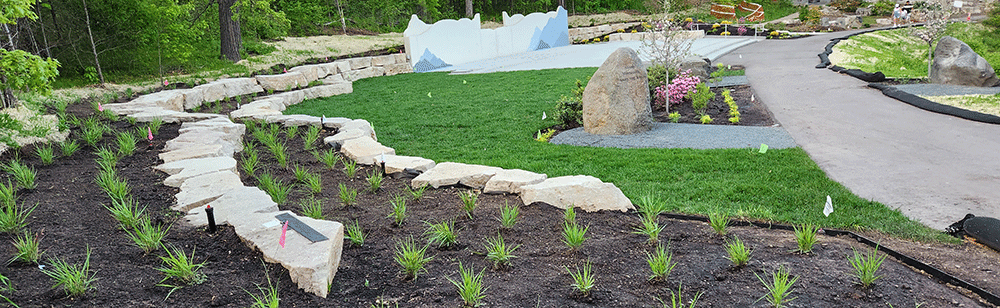
Rice Terrace Rock/Grass Borders embrace the Hmong Plaza and are significant Hmong cultural symbols. The Hmong grow rice in terraces in China, Laos, and Vietnam, and rice is the traditional principal food of the Hmong. Rock borders represent how Hmong traditionally use rocks to set boundaries for protection. Grass represents the principal food for their domestic animals.
Hmong Art Stones
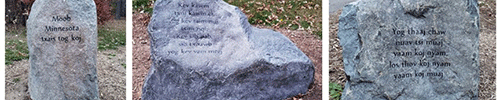
There are three Hmong art stones in the China Friendship Garden that represent the significance of the number 3 in Hmong culture, which begins with the three legs of the metal stoves that were used by each family not only to cook food, but also to provide warmth and light in the cold and darkness. The word “peb” is “three” in Hmong, which is also a homophone for the word “we/us.” This signifies how individuals, like the three legs of a stove, need each other to support and uphold the community.

Moob Minnesota txais tog koj.
Hmong Minnesotans welcomes you.
The text for the first stone was chosen by the Hmong Advisory Committee to express the sentiment of Hmong Minnesotans to welcome all communities from near and far into our home of St. Paul. It also reflects the caring and open nature of the Hmong people, as well as their gracious hospitality. This stone is the largest of the 9 Art Stones, and represents the importance of cultivating a welcoming nature in Hmong culture.
The head of the stone represents the peak of the Mountain, and is a visual connection to the geographical history of the Hmong people and their former lives in the mountains of Laos. The engraved text is located at the “heart” of the stone, symbolizing the Hmong Minnesotan community opening their heart to all visitors. The natural formation on the back of the stone curves and portrays a seat on the stone, representing how the Hmong people are ready to support anyone and how villages are willing to open up their own homes to help those in need.
Weighing 7,100 pounds, this stone is local granite from Rivard Stone, Houlton, WI, engraved by Steve Martens.

Kev kawm txuj, kawm ci yog kev tsim nuj, tsim nqi; Kev sib pab, sib txhawb yog kev vam meej.
Education is knowledge, knowledge is wisdom; The path to success is by helping and supporting each other.
The text for the second stone emphasizes that education is the foundation of successful communities. This quote reflects the goals and dreams of immigrants and how immigrant communities flourish when they come together and support one another. This text also serves as a reminder to future generations to appreciate their roots, culture, and community as they harvest the fruits and successes of generations that came before them. The shape of the stone is similar to that of a large seed, which relates to planting seeds of life, as well as planting seeds of knowledge for the next generation. The shape of the stone at the bottom represents two feet firmly rooted in the ground and again symbolizes the importance of education as the foundation.
Weighing 3 tons, this stone is local granite from Rivard Stone, Houlton, WI, engraved by Steve Martens.
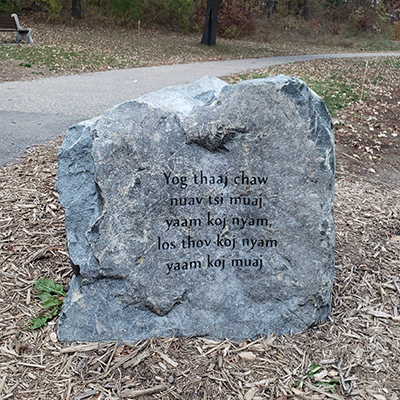
Yog thaaj chaw nuav tsi muaj yaam koj nyam, los thov koj nyam yaam koj muaj.
If this place does not have what you like, please like what you have.
The third Hmong stone has a proverb translated into Hmong that has been passed down orally for many generations. This quote is found at the Royal Garden of the King of Northern Laos and at the Northern Resort of Chiang Mai in Thailand. This proverb serves as a remembrance to all the Hmong people of their history, how far they have come and the resilience they possess.
On the side opposite the engraving, the composites in the stone formation resemble the shape and flow of a river from the mountain tops to the valleys. This flowing river represents the three major rivers that are significant to each culture involved in this project: the Mekong River (dividing Laos and Thailand), the Xiang River (through the heart of Changsha), and the Mississippi River (through the heart of the Twin Cities).
Weighing 2 tons, this stone is local granite from Rivard Stone, Houlton, WI, engraved by Steve Martens.